


Handmade Swimwear vs Fast Fashion: The Real Value of Limited Editions
· 7 min read

We live in an age of total immediacy and excessive production. Every season, the textile giants flood physical and online shelves with millions of identical garments, made thousands of miles away on automated assembly lines where speed comes before stitching and volume swallows up individuality. In this throwaway ecosystem, swimwear has been aggressively standardised: thin Lycra that gives way after the second swim, generic patterns that ignore the diversity of bodies and wardrobes full of clone pieces that end up forgotten after a single holiday.
Against this industrial sameness, a conscious resistance is rising: designer, handmade, limited edition swimwear.
At Quelton we don't see design as a mass-production race or an algorithm of fleeting trends. Our story didn't begin in a boardroom or a mechanised factory; it was born around our mother's sewing machine, out of a real, everyday need: the frustration of not finding swimwear on the market that was beautiful, had character and a pattern that truly flattered a real woman's body. Today, that same machine still sets the ethical, technical and creative pulse of every piece that carries our label.
Understanding the value of a limited edition isn't just about appreciating aesthetic exclusivity; it means understanding the human, technical and qualitative process that separates a handmade piece from a mass-produced product.
1. What sewing “piece by piece” really means
The word “handmade” has often become an empty marketing claim. But in the world of swimwear construction, craftsmanship translates directly and tangibly into the strength of the thread, the feel of the fabric and the way the piece hangs.
Precision versus the speed of bulk cutting
In fast fashion factories, rolls of fabric are stacked in layers dozens of metres thick and cut in one go with automated mechanical blades. Although this method saves time and money, the middle layers are put under uneven tension: the first layer never measures exactly the same as the last. The result is variations of several millimetres between garments labelled with the same size.
In a local artisan workshop — like the family workshops in Portugal where the vast majority of our collections come to life — the process is the complete opposite:
-
Each length of metallic or printed fabric is laid out, left to rest to release the tension in the elastic fibres and cut individually or in very small runs.
-
The pieces are assembled by hand by experienced seamstresses who guide the fabric under the needle millimetre by millimetre.
-
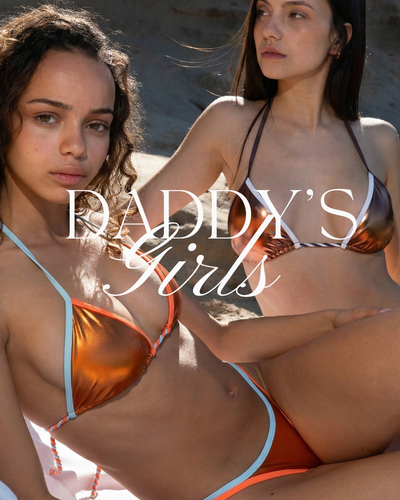
Machine tension is adjusted to the exact stretch of the thread and the thickness of the fabric (essential for the metallic finishes of collections such as Bandida, Daddy's Girls or the Bronze line).
The result of this meticulous handwork is a piece that feels firm when you put it on, doesn't sag, doesn't pinch the skin and keeps its original shape after countless dips.
2. Anatomy of a limited edition: exclusivity versus overproduction
The concept of a limited edition at Quelton rests on two unbreakable principles: exclusivity for the woman who wears the piece and total respect for the production cycle.
| Parameter | Mass production (fast fashion) | Quelton limited edition |
| Volume per style | Tens of thousands of identical units | Small, numbered runs |
| Traceability | Offshored, opaque supply chains | Supervised local workshops in Portugal and Spain |
| Restocking | Constant restocking that saturates the market | Once an edition sells out, it's gone |
| Environmental impact | Destruction of unsold surplus | Zero overproduction: stock matched to real demand |
| Design approach | Quick copies of micro-trends | Original patterns perfected by hand |
When we launch a run on the basis that, once sold out, it will never be made again, we guarantee two essential things:
-
Your look is truly yours: Bumping into someone on the beach, at a beach bar or at a festival wearing exactly the same bikini is practically impossible. Wearing a limited edition gives you the peace of mind of a distinctive piece, designed to stand out rather than blend into the crowd.
-
No dead waste: The textile industry's great environmental scourge is burning or dumping millions of tonnes of surplus stock that nobody bought. Making careful, measured runs avoids excess inventory and ensures every metre of fabric cut ends up in the wardrobe of someone who values it and enjoys it for years.
3. Refined pattern-cutting: millimetres that change a silhouette
Anyone who has tried on a bikini knows that half a centimetre more or less in the rise of the bottoms or in the distance between the cups of a top completely transforms how a piece looks on the body.
In large-scale industrial production, patterns are graded automatically and mathematically by computer software: they grow or shrink proportionally in every direction, ignoring the fact that a size L body isn't simply a size XS body enlarged by 20%.
Developing each pattern in our workshop is an iterative process that can take months before it sees the light of day:
-
Fittings on real bodies: We adjust every line on women of different builds, checking how the piece behaves when sitting down, swimming, sunbathing or walking.
-
The balance between firmness and comfort: We fine-tune the stretch of the hidden seams so the bottoms frame the bum with a flattering cut without unwanted pressure on the hips, and we structure the tops (whether balconette, triangle or sporty) to give real support that doesn't rely on painful underwires or rigid padding.
-
Respect for the raw material: As metallic fabrics have a firmer, more compact stretch than standard Lycra, each style is redesigned from scratch to suit the physical behaviour of that specific fabric.
4. Proximity and ethics: the know-how of Portuguese workshops
Choosing where garments are made defines a brand's identity as much as its visual campaigns. Placing most of Quelton's production in workshops in Portugal isn't a random decision; it reflects a centuries-old textile tradition recognised worldwide for its craftsmanship, rigorous labour standards and technical excellence.
Choosing local production on the Iberian Peninsula brings values that no offshore factory on the other side of the world can replicate:
-
A direct human relationship: We don't work with anonymous middlemen. We visit the workshops, know the names of the people who cut and sew each bikini, and personally oversee the samples and the finish of every seam.
-
Decent working conditions and fair wages: Every piece is made under strict EU legislation, guaranteeing safe working environments, regulated hours and fair pay for skilled workers.
-
A drastically smaller carbon footprint: By producing just a few hundred kilometres from our distribution centre and our customers, we cut out massive transcontinental sea or air freight, minimising the greenhouse gas emissions associated with transporting goods.
5. Cost per wear: why buying better is the truly smart investment
One of fast fashion's great traps is the illusion of affordability. Buying a bikini for twenty euros seems like good value at first glance, until you look at its real life cycle: after two weeks at the beach and three washes, the fabric has stretched, the cups have lost their shape, the seams have frayed and the colour has lost all its intensity. The usual result is throwing the piece away and buying an identical one the following year.
In contrast, designer handmade fashion follows the principle of cost per wear (cost-per-wear):
-------------------------------------------
Total number of times you wear it
A bikini made from premium materials, hard-wearing metallic finishes and hand-reinforced seams is designed to keep its structure, stretch and shine intact season after season. Add its versatility as a going-out top or a key piece for sundowners and festivals, and it quickly pays for itself.
Investing in a well-made piece isn't a frivolous expense: it's a smart, lasting and responsible buying decision that replaces impulse accumulation with pieces that truly make you feel unique.
6. The Quelton manifesto: No basic, stay iconic
The easy path in the fashion industry is to give in to mass production, cut costs with cheaper fabrics and churn out thousands of identical units to feed the wheel of frantic consumption. The hard path, but the only one we believe in, is to stay true to the original sewing machine: caring for every seam, listening to our community, producing limited runs that respect the workshop's pace and creating pieces with their own personality that celebrate the female body.
The mantra No basic, stay iconic isn't just a slogan on a label; it's our promise that every time a box arrives at your door, you touch the fabric and look in the mirror, you'll feel the dedication, strength and authenticity of a piece created to let you shine in your own light.
Want to be part of the shift towards more conscious, exclusive fashion? Discover our current limited editions on the website before they sell out for good, and share your energy with our community at #IconicQueltons.


